Kennings & AI Poetry
Where ancient Norse metaphors meet modern artificial intelligence
Kennings are one of the most distinctive features of Old Norse and Old English poetry—compound expressions that describe familiar things through unexpected metaphorical combinations. These poetic puzzles transform the mundane into the magical, the known into the mysterious.
History
Skaldic poetry emerged in Scandinavia during the Viking Age (late 9th century) and flourished through the Middle Ages (into the 14th century). It likely began at the courts of Norwegian kings and jarls, where poets (called skalds) served as esteemed chroniclers and entertainers. Skalds enjoyed high status and reward for their art.
A kenning is a metaphorical compound or phrase that replaces a simple noun, often in a two-part (or multiple-part) construction. In essence, it is a riddle-like description: two nouns are put together to allude to a third thing, which is the kenning's actual meaning. For example, instead of "sea," a skald might say "whale-road" or "swan's riding-place"—evoking the sea through an image of the creatures that travel on it. A battle might be called a "storm of swords," and blood may be poetically termed "battle-sweat." A warrior can be depicted as "raven-feeder," meaning one who provides food to ravens by killing enemies. These kennings, often compact and vivid, were a defining feature of skaldic style.
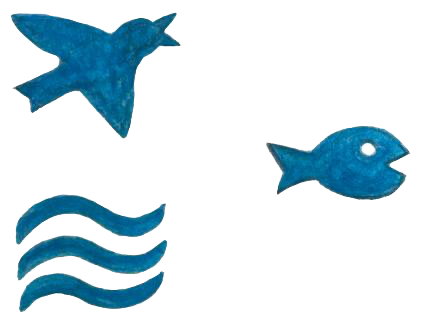
[Bird] of the [Sea] is [Fish]
Kennings range from relatively transparent to extremely elaborate. Simple kennings might be two-word compounds (e.g., "gold-giver" for a generous lord, or "shield-test" for battle). More complex kennings could involve multiple layers: one element of the kenning is itself replaced by another kenning. For instance, a skald might not say "raven-feeder" directly; instead, they could substitute "corpse-gull" for "raven," yielding a double kenning like "gull of corpses' feeder" to still mean "warrior." In theory, kennings could be nested several layers deep, creating an ornate poetic puzzle where only an initiated listener, well-versed in the conventions and Norse mythological references, could untangle the meaning. Indeed, kennings are often described as "riddle-like circumlocutions" that require the audience to mentally solve the metaphor. Part of the pleasure and prestige of skaldic poetry lay in this intellectual game: the poet challenges the listener to decipher the imagery.
While certain kennings might be traditional or commonly known, skalds also strove to be inventive—often coining unique kennings on the spot. The corpus of skaldic poetry contains on the order of ten thousand kennings, most of them unique, with each poet pridefully inventing new ones for their context.
Stylistically, kennings served multiple roles: they were aesthetically pleasing, mnemonically useful, and marks of poetic skill. A line like "the feeder of ravens reddened the wolf's sea with the sword's song" unpacks into a straightforward idea ("the warrior spilled blood in battle") but conveys it through four kenning phrases that each evoke a vivid scene and tie into the larger Norse symbolic universe (ravens and wolves on the battlefield, swords singing, blood as a sea).
The influence is even apparent in everyday language—many common English metaphorical compounds ("skyscraper," "ankle-biter," etc.) have been playfully likened to kennings, showing how intuitive this form of expression can be.
The kenning functioned as both puzzle and poetry—compressing stories and sensations into compound metaphors.
Modern Kennings Through AI
We are not Vikings anymore. So it doesn't make sense to just illustrate historical kennings (however beautiful they may be—and they are truly amazing).
How AI Creates Kennings
We use Anthropic Claude models—which are the most poetic LLMs for language ever created (personal statement). Since Claude Opus 3, Claude Sonnet 3.5, Claude Sonnet 3.6, Claude Sonnet 4.0, and Opus 4.0, we get amazing imagery of poetic language.
Illustrations
Words in kennings are intended to create images in the listener's mind. We use them to feed into the best image generation models (via meta-prompting transformation to enhance visual appeal) and render via the best-of-breed MidJourney V7 model with custom tuning.
To learn more about this process, head to About Illustrations
Examples from Our Collection
The Poetry of Connection
What makes these AI-generated kennings special is not just their adherence to traditional forms, but their ability to capture genuinely insightful observations about modern life.
Each kenning in our collection is more than a clever word combination—it's an invitation to see the world differently, to find the extraordinary in the ordinary, just as the ancient skalds did.
Continuing the Tradition
By using AI to create new kennings, we're not replacing human creativity but extending a tradition that has always been about innovation and experimentation. The Viking poets would likely appreciate this new tool in the skald's workshop—after all, they were the linguistic innovators of their time.
The Kenning Collection demonstrates that AI can be a bridge between past and future, helping us rediscover and reimagine cultural treasures for new generations.